Friends

12 March 2015

Lunching out...


Saturday lunch at the restaurant was a dazzling affair, the sun on the lake almost forcing us to draw the blinds. Most enjoyable, pity the next day was so wet.

When two swans came into view I wondered if they would avoid the obstacle in the water


But no, they sailed right over it!


Joe and I still manage to dine out on Saturdays since his hospital visits are confined to weekdays. He had a spell in hospital last week, when a stent was fitted to or in an artery. It was to help blood to flow more freely and keep his heart ticking. Mind you, I think it might have been an excuse to have a week off housework, since he was forbidden to do any. Nor could he drive for a week 
(whisper - I wonder which doctor came up with THAT idea. Couldn't have been a man, surely!).

And the good news is - we are going to have some wonderful Spring weather. 
I'll keep you posted on that.

09 March 2015

Town Crier


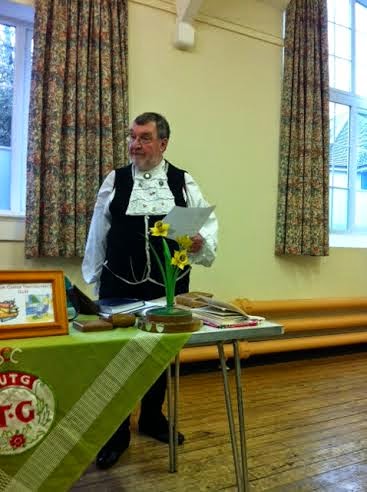
There was an interesting speaker at the Townswomen’s Guild (TG) the other week. It was Ken Knowles, Town Crier for Lichfield, one of our neighbouring cities. Ken was resplendent in his red outfit. He was a portly gent, just how I always pictured a town crier to be. When he arrived he walked into the room waving his big bell and shouting O-yez, O-yez. There was thunderous applause once we’d unplugged our ears.
(Ken Knowles)
Town criers used to be officers of the court who made public pronouncements as required. They could also make public announcements in the streets. Dating from the 28th century the criers dressed elaborately, in red or gold, with white breeches, black boots and a tricorne hat. They always carried a handbell in order to attract attention, and would cry O-yez, meaning ‘hear ye’ which was a call for silent attention.  

However, times do change and the need for town criers disappeared. However, local councils reinstated the position for ceremonial purposes which I can honestly say are wonderful to watch. My Dad and I used to pop over to Lichfield to see the Lichfield Bower which was always held on the Spring Bank Holiday.

Here’s a piece about it, found in Wikipedia.

The Origins of the bower go back many centuries to the time of Henry II (1145-1189). At that time England had no standing army and when the King needed troops to defend the realm he had to raise them by mustering all the able bodied men between the ages of 16 and 60 throughout the kingdom.
To enable him to do this Henry set up a Commission of Arraye (an early example of quango) which had every year to submit to the king, a return of all the men-at-arms available throughout the kingdom. To do this they ordered every city and town to hold a muster of fighting men on one day in the year and to send the figures in to the Commission of Arraye. These musters were known as the Courtes of Arraye, and in Lichfield the Courte if Arraye was always held on Whit Monday.
It was held at Greenhill, where a “Bower House” was erected and decorated with laurel and lilac. Here the men-at-arms mustered before the magistrates with their arms and armour and were regaled with free beef and wine. At the end of the day the magistrates sent a return of the numbers to the Commission of Arraye in London. As an example of this, in 1604 the report of the Commission contained the following: “Leichfield Town, able men 285; armed men 150; pioneers 50; high horses 50”.
At Lichfield someone must have decided that having got all the men-at-arms together it was a pity not to do something with them, and so they were paraded around the streets of the city. They were accompanied by the Lichfield Morris dancers with drum and tabor and by people from the churches carrying figures of saints garlanded with flowers. Whitsun being as important festival of the Church: these garlanded figures were known as “posies”.
After the Reformation, the figures of saints were replaced by the tableaux representing different trades, but the term “posie” was still used to describe them.
The introduction of gunpowder led to musketeers being included in the procession. When the procession halted outside the horses of the principal citizens, the musketeers would fire a volley over the house, whereupon the principal citizen was expected to offer cakes and ale to those in the procession.
This went on all day, until late in the evening the participants staggered into the Market Place to be dismissed by the Town Clerk.
By the time of James II the country has a standing army, famous regiments such as the Coldstream and Grenadier Guards and the Royal Scots were already in existence, and it was decided that the Commission of Arraye was no longer needed. So it was abolished in 1690 and Courts of Arraye ceased to exist throughout the country – except in Lichfield where the inhabitants decided that as they enjoyed Bower Day so much they would continue to observe it. And this they have done right up to this day.
Most of the ancient features of the Bower still survive – the Court of Arraye is held in the Guildhall, when the Mayor inspects the “men-at-arms” the procession through the streets includes the Morris Dancers and military bands, and the place of the posies has been taken by the tableaux mounted on lorries and trailers. But, as in the past, the principal feature of the Bower is a jolly good day out for all.


According to Ken there are now only fifteen criers in this country but they have a great time entering competitions for the best delivered speech. Our man had won several trophies, which he brought to show us.
(Ken, showing what went underneath the coat!)
(The daffodil display is actually a recent trophies he won) 

Ken gave the most interesting and riveting talk, with plenty of humour interspersed, and I shall definitely be inviting him to talk to the WI next year. 

07 March 2015

Songs and Sounds on Saturday

For several days this song has flooded my brain. It is strange how that happens and I wonder why we can't just switch off?

Katie Melua has a distinctive style, don't you think?

02 March 2015

A welcome awaits....


A recent travel programme on television reminded me of an incident in another part of the UK. Another nation, actually.

The UK comprises these nations, England, Scotland, Wales, and Northern Ireland. Hence the name United Kingdom. However, the word ‘united’ is a misnomer – according to the history books it was never thus. But we grow up, don’t we, and learn to get on with people of all nationalities and denominations. Or we should!

It is a sad fact that certain people on these islands don’t like their neighbours and it was a much publicised fact that the Welsh didn’t like the English. Nevertheless, Wales is a lovely place to visit, which is what we did one summers day, many years ago.

I think we were in Machunclyth at the time but I could be wrong about that. The memory fades with age, you know. Anyway, we were definitely by the sea. One thing I noticed was that certain shopkeepers didn’t speak. A purchase could be made and the sale completed without a word exchanged, yet conversations would be in progress with other folk in the shop. Sometimes there would be a noticeable change of language - moving rapidly from English to Welsh. 

It took a while for it to dawn on me that we were English and some people didn’t like us. Joe thought I was being daft. ‘People aren’t like that,’ he said, being a tolerant man who always sees good in people. However, the next incident brought it home that maybe I was right.

We had taken Goldie, our first Labrador, who adored the seaside. He was a friendly dog and loved to mix with other dogs when the occasion arose. On this particular occasion Goldie had had his run on the sand and we were just standing there enjoying the weather and the view.

Walking down the lane behind us was a young lady and an older man, maybe daughter & father, with a small dog on a lead. Naturally, Goldie wanted to say hello and ran towards the couple. The woman promptly snatched her dog up and bellowed to us to ‘remove’ our dog. I called out that Goldie was friendly and wouldn’t hurt her dog, at the same time calling him to heel. It didn’t help. The woman was outraged.

The incident passed when the couple and their dog moved on. Or so we thought. A few minutes later we moved away from the spot, walking to where our car was parked. Imagine our surprise and horror when they passed us in their car to hear the woman screaming ‘GET BACK TO YOUR OWN B***** COUNTRY.’ 

I don’t think I’ve been back to Wales since but I did learn from English friends that similar experiences were shared. How sad is that? 

I have yet to work out how divided turf can change people's opinions of each other.